Top 10 Daily Puzzle Games to Play Every Day (2026)
You already know the feeling. You solve one puzzle, close the tab, and the next morning you are back for more. That tiny streak counter has more power over you than any alarm clock.
But most people get this wrong. They pick too many games, burn out in a week, and drop all of them. The right daily puzzle should still feel rewarding six months from now.
This list covers the 10 best daily puzzle games available right now. What each one feels like, where it shines, and where it falls short. By the end you will know exactly which ones deserve a spot in your day.
Why Daily Puzzle Games Are So Addictive
Most games reward you for playing more. Daily puzzle games reward you for coming back. The puzzle resets every 24 hours, so the only way to keep your streak is to show up.
There is also a social layer. When everyone plays the same puzzle on the same day, results become shareable. Your score is not just about how well you did. It is about how you compare to everyone else.
Why the habit sticks:
- 🔁 One puzzle per day creates a natural routine
- 🔥 Streaks make skipping a day feel painful
- 🧠 The completion feeling at the same time daily becomes rewarding
- 👥 Shared puzzles create conversation and friendly competition
How NYT Style Puzzle Games Took Over
Wordle went viral in 2021 and changed the entire puzzle industry. One daily challenge, simple rules, shareable colored grid. The New York Times acquired it in January 2022 and built a whole game collection around the same format. Check out the history of the NYT Games.
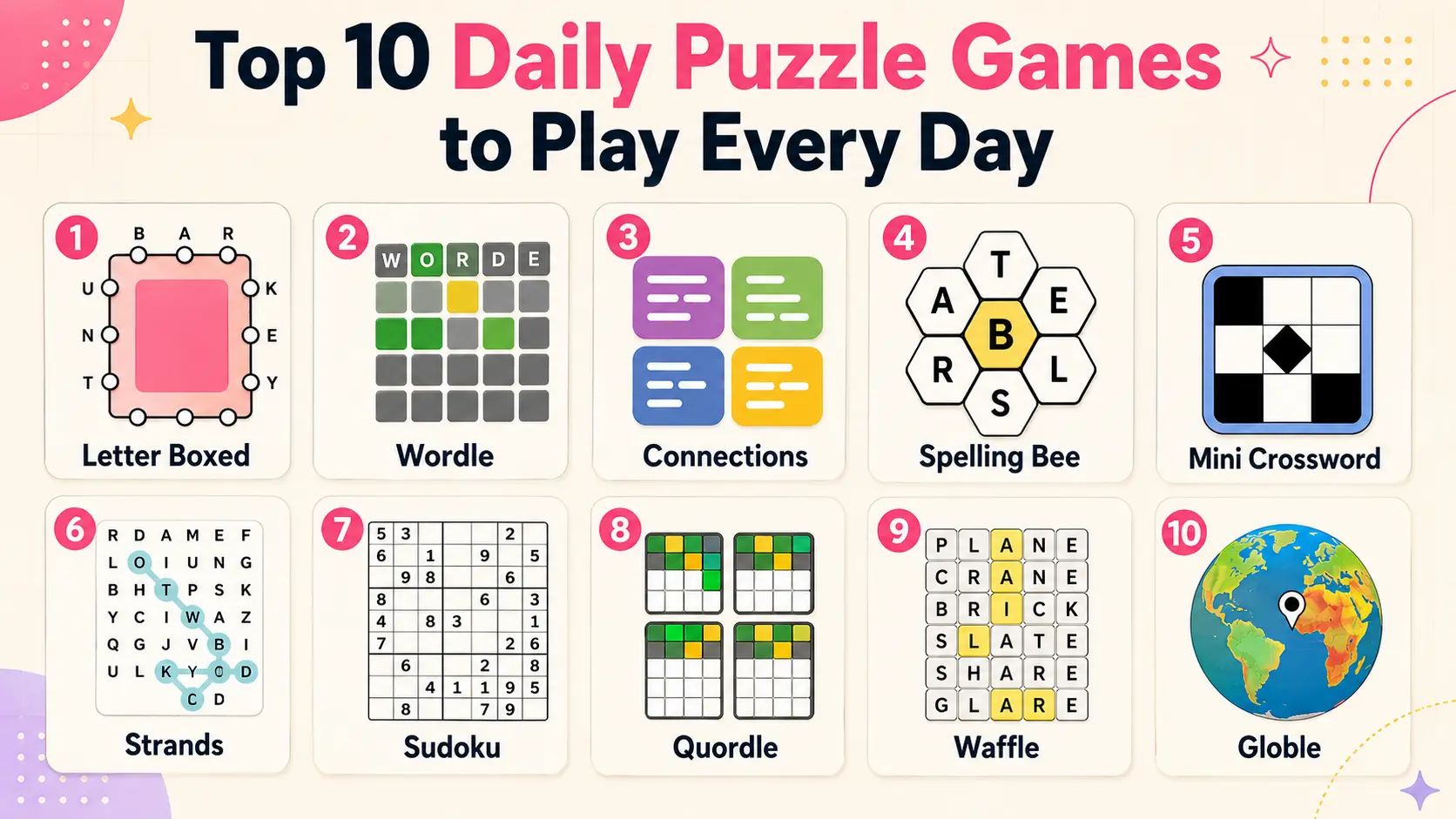
The NYT Games lineup now includes:
- 🟩 Wordle
- 🔲 Letter Boxed
- 🐝 Spelling Bee
- 🔗 Connections
- 🧵 Strands
- ✏️ Mini Crossword
Third party developers followed with geography games, math games, music games. Nearly every subject got a daily puzzle version because the format just works.
1. 🔲 Letter Boxed
Best for: Strategic word players who want more than a vocabulary test
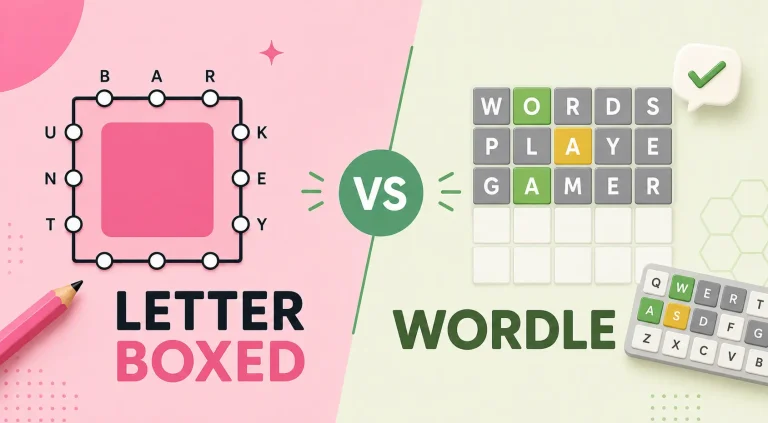
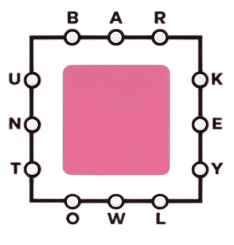
How it works: Twelve letters sit on four sides of a square, three per side. Build a word chain that uses every letter at least once. Each word starts with the last letter of the previous one. No two consecutive letters can come from the same side. Play Letter Boxed unlimited for free and practice as many boards as you want.
What makes it different:
- 🧩 It is a spatial problem as much as a vocabulary one
- 🎯 Two word genius solve is the community gold standard
- 📈 Scales naturally: beginners use 5 words, pros chase 2
- ♾️ Daily mode plus unlimited practice mode
| ✅ Strengths | ❌ Weaknesses |
| Deep strategic thinking every session | Steeper learning curve than most word games |
| Free daily play available | One tricky letter can ruin an entire chain |
| Scales well as your skill improves | No built in hint system |
| Unlimited practice mode | Invalid word rejections frustrate new players |
| Satisfying when a long chain clicks | Official NYT version needs subscription |
⏱️ Session time: 5 to 15 minutes 📊 Difficulty: Medium to Hard
Official NYT version needs subscription. If a board has you completely stuck, grab today’s Letter Boxed answers to study the word chains and learn what you missed.
2. 🟩 Wordle
Best for: Everyone, especially players who want a fast satisfying daily habit
How it works: Guess a hidden five letter word in six attempts. After each guess you get color feedback: green (right letter, right spot), yellow (right letter, wrong spot), gray (not in the word).
Why it became massive:
- 🌍 Shareable colored grid went viral on social media in 2022
- 💰 NYT acquired it for a reported seven figures
- 📱 Proved that one puzzle per day at massive scale works
- 🗣️ Millions post results daily without spoiling the answer
| ✅ Strengths | ❌ Weaknesses |
| Anyone can learn it in 60 seconds | Only one puzzle per day |
| Takes just 2 to 5 minutes | Difficulty varies wildly day to day |
| Hugely shareable results | Can feel repetitive after months |
| Strong worldwide community | No difficulty settings |
| Free to play | NYT account needed for streak tracking |
⏱️ Session time: 2 to 5 minutes 📊 Difficulty: Easy to Medium
3. 🔗 Connections
Best for: Pattern recognition lovers who enjoy lateral thinking
How it works: Sort 16 words into four groups of four. Each group shares a hidden theme. The connections are rarely obvious, and words that look like natural pairs usually do not go together the way you expect.
The difficulty arc:
- 🟡 Yellow (easiest) builds confidence
- 🟢 Green tests your knowledge
- 🔵 Blue requires creative thinking
- 🟣 Purple (hardest) feels like a mental workout
| ✅ Strengths | ❌ Weaknesses |
| Teaches flexible thinking | Can feel unfair on hard days |
| Takes 5 to 10 minutes | No partial credit for wrong guesses |
| Four difficulty levels | Cultural references can exclude non US players |
| New theme daily keeps it fresh | Some themes need niche knowledge |
| Strong shareable format | One puzzle per day, no replay |
⏱️ Session time: 5 to 10 minutes 📊 Difficulty: Medium
4. 🐝 Spelling Bee
Best for: Vocabulary lovers who want a puzzle with no finish line
How it works: Seven letters in a honeycomb shape. Every word must include the center letter. Reuse letters as much as you want. Find enough words to reach Genius rank, or chase Queen Bee by finding every valid word.
What makes it special:
- 📚 Best vocabulary builder on this entire list
- ⏰ No hard endpoint, return throughout the day
- ⭐ Finding a pangram (all 7 letters) delivers a special rush
- 📈 Regular players notice real vocabulary improvement after months
| ✅ Strengths | ❌ Weaknesses |
| Exceptional for vocabulary growth | Can eat more time than planned |
| Flexible play throughout the day | Some common words get rejected |
| Pangrams feel amazing to find | Subscription needed for full streaks |
| No wrong answer penalty | No clear win condition for casual players |
| Scales from casual to obsessive | Can consume perfectionist players |
⏱️ Session time: 10 to 30 minutes 📊 Difficulty: Medium to Hard
5. ✏️ Mini Crossword
Best for: Busy people who want a full crossword in under 5 minutes
How it works: A 5×5 crossword grid with a small set of across and down clues. Same structure as a full crossword but scaled down to fit a coffee break.
Why busy players love it:
- ⚡ Fastest puzzle on this entire list
- 🏋️ Works as a warm up before harder puzzles
- 📅 Short enough that you never skip a day
- 🧠 Builds crossword solving habits over time
| ✅ Strengths | ❌ Weaknesses |
| Just 2 to 5 minutes | Too short for depth seekers |
| Full crossword structure | Difficulty is inconsistent |
| Free to play | Clues can be US focused |
| Great for building streaks | Limited vocabulary challenge |
| Beginners and experts both enjoy it | Streak tracking needs NYT account |
⏱️ Session time: 2 to 5 minutes 📊 Difficulty: Easy
6. 🧵 Strands
Best for: Word search fans who want something smarter
How it works: An 8×6 letter grid where you find words connected to a hidden daily theme. Words stretch in any direction and must use every letter with no overlap. Each puzzle has a spangram that spans the entire board.
The twist: The puzzle tells you the theme but not the words. You figure out both what the words are and whether they fit.
| ✅ Strengths | ❌ Weaknesses |
| Creative theme puzzles daily | Obscure themes can be very hard |
| Spangram mechanic is rewarding | Smaller community than older NYT games |
| Full board coverage, no wasted letters | Some boards take much longer |
| More visual than other word games | Hint system borrows from other puzzles |
⏱️ Session time: 5 to 15 minutes 📊 Difficulty: Medium
7. 🔢 Sudoku
Best for: Logic lovers who want zero language requirement
How it works: A 9×9 grid partially filled with numbers 1 through 9. Each row, column, and 3×3 box must contain every number exactly once. No guessing needed. Every move can be worked out through pure logic.
Why it never gets old:
- ♾️ Infinite variety, no two grids are the same
- 🌐 Works in any language for any age
- 📊 Multiple difficulty tiers from easy (10 min) to expert (45 min)
- 🧠 Zero vocabulary or general knowledge needed
| ✅ Strengths | ❌ Weaknesses |
| Pure logic, no language barrier | No social or shareable layer |
| Multiple difficulty levels | Session length varies widely |
| Infinite variety | Can feel mechanical |
| Works for any player globally | No vocabulary benefit |
| Free on countless sites and apps | Many apps have aggressive ads |
⏱️ Session time: 5 to 30 minutes 📊 Difficulty: Easy to Hard
8. 4️⃣ Quordle
Best for: Wordle veterans who find the original too easy
How it works: Wordle’s mechanic times four. Every guess applies to all four boards at once. Nine attempts to solve all four words. Managing four sets of clues from a shared guess pool is a genuinely different skill.
The jump from Wordle: A guess perfect for boards 1 and 3 might be useless for boards 2 and 4. Learning to balance all four boards is what makes it addictive.
| ✅ Strengths | ❌ Weaknesses |
| Much harder than Wordle | Beginners will struggle early |
| Free with no account needed | Nine guesses feel limited fast |
| Daily and practice modes | Smaller community than Wordle |
| Teaches guessing efficiency | Long term availability uncertain |
⏱️ Session time: 5 to 15 minutes 📊 Difficulty: Hard
9. 🧇 Waffle
Best for: Players who enjoy rearranging and spatial puzzles
How it works: A crossword style grid with six five letter words, but the letters are scrambled. All letters are there, just in the wrong spots. Swap them into place using 15 moves or fewer. A perfect solve in 10 moves earns five stars.
What makes it unique: You never search for words. The words are already decided. You solve a spatial puzzle about letter placement, closer to a sliding tile puzzle than a word game.
| ✅ Strengths | ❌ Weaknesses |
| Unique mechanic | Six words at once can overwhelm |
| Just 3 to 8 minutes | Yellow letter logic takes practice |
| Visually satisfying | Limited community |
| Star rating rewards efficiency | No practice mode |
⏱️ Session time: 3 to 8 minutes 📊 Difficulty: Medium
10. 🌍 Globle
Best for: Geography fans who want a daily world map challenge
How it works: Guess the mystery country. After each guess, the country turns a color based on distance. Blue means far away. Red means close. Each guess narrows the field based on geographic proximity.
No specialist knowledge needed. You do not need to recognize country shapes or memorize flags. Just a reasonable mental map and the ability to think about distance. Finding the answer in 3 guesses or fewer is exceptional. Most players land between 5 and 10.
| ✅ Strengths | ❌ Weaknesses |
| Genuinely teaches world geography | Only appeals to geography fans |
| Heat map mechanic is clear | No vocabulary benefit |
| Quick 3 to 10 minute sessions | Less social than word puzzles |
| Free with no account needed | Obscure countries can feel unfair |
⏱️ Session time: 3 to 10 minutes 📊 Difficulty: Easy to Medium
Which Daily Puzzle Game Is Right for You?
The best daily puzzle is not the most popular one. It is the one that fits your routine and still challenges you months from now. Here is a quick guide by goal:
📚 Best for Vocabulary Building
| Rank | Game | Why |
| 1 | Spelling Bee | Broadest vocabulary exposure per session |
| 2 | Letter Boxed | Forces you to think about word structure |
| 3 | Wordle | Reinforces five letter word awareness |
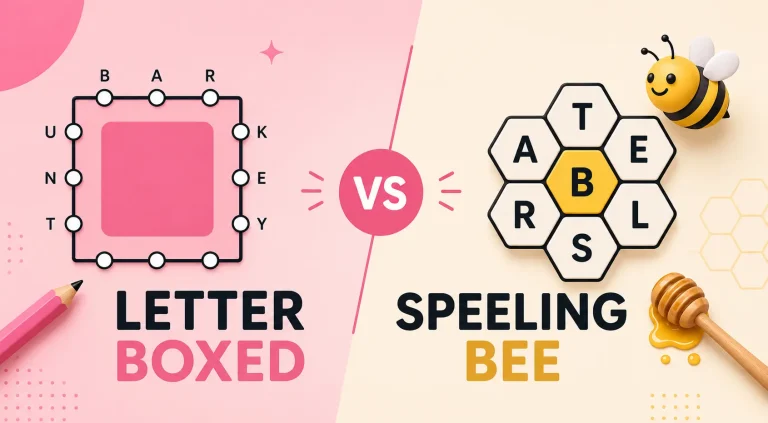
Our Letter Boxed vs Spelling Bee comparison explains exactly how their strengths differ.
🧠 Best for Logic and Strategy
| Rank | Game | Why |
| 1 | Sudoku | Purest logic puzzle, no language needed |
| 2 | Letter Boxed | Multi step chain planning |
| 3 | Connections | Lateral thinking and pattern recognition |
⚡ Best for Quick Sessions (Under 5 Minutes)
| Rank | Game | Why |
| 1 | Mini Crossword | 2 to 5 minutes, full crossword feel |
| 2 | Wordle | 2 to 5 minutes, easy to complete |
| 3 | Globle | 3 to 10 minutes, geography focus |
🕐 Best for Long Sessions (15+ Minutes)
| Rank | Game | Why |
| 1 | Spelling Bee | No finish line until Queen Bee |
| 2 | Sudoku (Expert) | 20 to 45 minutes per puzzle |
| 3 | Letter Boxed Unlimited | Endless practice boards |
Full Comparison Table
| Game | Difficulty | Time | Vocab | Logic | Replay | Cost |
| 🔲 Letter Boxed | Med to Hard | 5 to 15 min | ⭐⭐⭐⭐⭐ | ⭐⭐⭐⭐ | High | Free |
| 🟩 Wordle | Easy to Med | 2 to 5 min | ⭐⭐⭐⭐ | ⭐⭐⭐ | Low | Free |
| 🔗 Connections | Medium | 5 to 10 min | ⭐⭐⭐⭐ | ⭐⭐⭐⭐ | Low | Free |
| 🐝 Spelling Bee | Med to Hard | 10 to 30 min | ⭐⭐⭐⭐⭐ | ⭐⭐⭐ | High | Free |
| ✏️ Mini Crossword | Easy | 2 to 5 min | ⭐⭐⭐ | ⭐⭐⭐ | Low | Free |
| 🧵 Strands | Medium | 5 to 15 min | ⭐⭐⭐⭐ | ⭐⭐⭐⭐ | Low | Free |
| 🔢 Sudoku | Easy to Hard | 5 to 30 min | ⭐ | ⭐⭐⭐⭐⭐ | High | Free |
| 4️⃣ Quordle | Hard | 5 to 15 min | ⭐⭐⭐⭐ | ⭐⭐⭐⭐ | Low | Free |
| 🧇 Waffle | Medium | 3 to 8 min | ⭐⭐⭐⭐ | ⭐⭐⭐⭐ | Low | Free |
| 🌍 Globle | Easy to Med | 3 to 10 min | ⭐⭐ | ⭐⭐⭐⭐ | Low | Free |
Final Verdict
If you play one game from this list, make it Wordle or Letter Boxed. They are the two most distinct daily puzzle experiences available right now.
- Wordle is the easiest starting point and the one most people around you already play
- Letter Boxed takes more effort but rewards you more over time with strategic depth that stays challenging for years
Best two game combo: Letter Boxed + Sudoku. One trains language skills, the other trains logic. Together they cover most of what daily puzzles are good for. Add Spelling Bee if you care about vocabulary growth. Add Connections if you enjoy lateral thinking.
One warning: Do not pick too many at once. Three or four daily puzzle habits tend to collapse into zero within a few weeks. Start with one, build the streak, and add a second only after the first has genuinely stuck. These games will still be here when you are ready. Not sure which one suits you better? Our Letter Boxed vs Wordle comparison breaks down the differences in detail.